
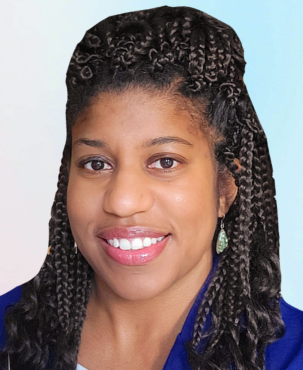
As a board-certified family physician with Los Angeles Christian Health Centers (LACHC), Dr. Kalaki Clarke promotes hope, healing, and health equity in The Skid Row District of Downtown Los Angeles—a community among more than 66,000 individuals experiencing homelessness in Los Angeles County.
Driven by her sister’s congenital medical condition, Dr. Clarke set her path on being a doctor by age 11. “I was fascinated that one human can go to another human to “get fixed,” so since childhood, I knew I was going to be a doctor,” she said. Her path to becoming a physician was non-traditional, with medical setbacks of her own as an adult, including experiencing major depressive disorder just six months after graduating from medical school.
Dr. Clarke openly shares her personal challenges with mental health and believes her relatability to some of her patients’ struggles gives her a greater capacity for empathy and positive influence.
"My personal experience with my mental health allows me to understand those feelings of isolation or not being appreciated, or not being part of mainstream society,” says Dr. Clarke. “It helps me to connect better with my patients."
After completing her residency at the University of California, Irvine, Dr. Clarke earned her Family Medicine Board Certification in 2017. “Formal training and board-certification provides me the necessary avenue to fulfill my purpose with LACHC,” she says, “and gives me the credibility and confidence to practice full scope family medicine and lets my patients know I am fully prepared to care for them.”
LACHC, a Federally Qualified Health Center, serves as the medical home for individuals and families in that community by providing comprehensive health care services and collaborating with multiple agencies in their efforts to transition patients out of homelessness. Being from South-Central L.A., Dr. Clarke views her service with LACHC as an opportunity to uplift her community that regularly experiences social injustices of racial discrimination, limited healthcare access, food insecurity, substance abuse and untreated mental illness.
Understanding that health outcomes and housing security are interconnected, Dr. Clarke sees them as human rights essential for health and wellness. “If I treat my patient for diabetes requiring insulin and they have no way of refrigerating it, my efforts in managing their condition are greatly impaired,” said Dr. Clarke. “Or, if my patient has housing but is medically uninsured, then their opportunity for maintaining wellness is limited. They are then a higher risk for illness and chronic disease.”
Dr. Clarke recognizes her patients have poor health outcomes when they lack the understanding of their health condition. “I make a conscious effort to educate my patients about their diagnoses and the purposes of each medication they take. They are more likely to adhere to their treatment plan when they understand their disease process and their medication benefits.”
As an African American female, Dr. Clarke represents nearly 3% of American physicians. Despite her training, she has experienced racism in her own career, yet remains undeterred and works to mentor other current and future health care workers of color. Dr. Clarke once introduced herself and completed a comprehensive medical visit with a 70-year-old white female patient who then asked, “When am I going to see the doctor?” Dr. Clarke simply replied, “Ma’am it’s a new day.” Conversely, the greatest words she’s heard from a patient: “You were born to help people like me.”